
RECOVER · CONCUSSION, WHIPLASH, HEADACHES & MIGRAINES
Still not right after the knock? Headaches that keep coming back?
Concussion, whiplash, headaches and migraines often involve the same systems: your brain, your neck, and your balance and vision. Our own assessment protocols test them under real world work load, so we can find which ones are involved, retrain them and get you back to work, school, sport and life.
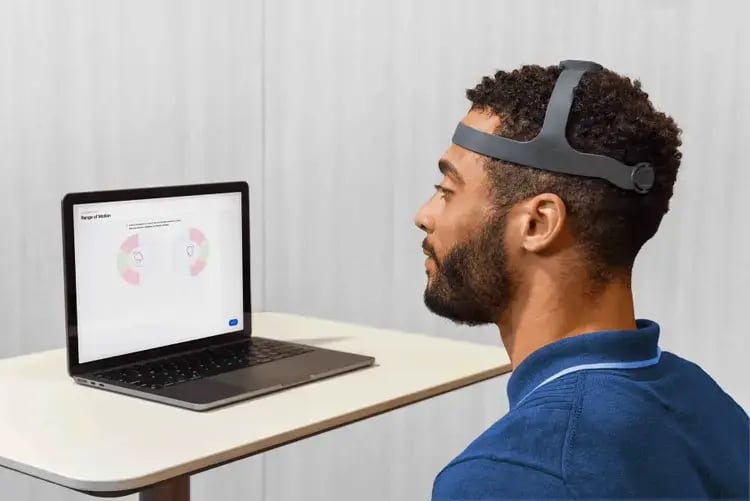
Does this sound like you?
Some of the most common reasons people come to us. Many have more than one.
Still foggy, tired or "off" weeks after a concussion
Persisting symptoms after concussion
Headaches since a knock, fall or accident.
Post traumatic headache
A sore, stiff neck since a car accident.
Whiplash (whiplash associated disorders)
Headaches that start in your neck.
Neck related (cervicogenic) headache
Migraines that keep coming back
Migraine, alongside your GP or neurologist.
Screens, reading or busy places set you off
Visual and motion sensitivity
Can't train, study or work like you used to
Return to sport, school or work
Worries about your child after a knock to the head
Children and teens, working with parents and schools.
AFTER THE FIRST FOUR WEEKS
Most people recover. Some don't. You're not imagining it.
Most people feel much better within a few weeks. But about 1 in 3 children and teens still have symptoms four weeks after a concussion [1], and around half of people with whiplash still have some neck pain a year later [2]. Symptoms beyond four weeks are called persisting symptoms [3]. They're common and recognised, and they usually come from more than one place.
Who’s more likely to have lingering symptoms
After concussion: adults who had trouble concentrating early on, a history of anxiety, depression or sleep problems, or who were knocked out or lost memory at the time [6].
After whiplash: higher pain and disability early on, plus stress, low mood or fear of moving [2]. People who become more sensitive to pressure, heat and cold soon after the injury are also more likely to still have moderate or severe symptoms at six months [7].
None of these mean you won’t get better. They tell us where to look, early.
What the guidelines say
10 days
If dizziness, neck pain or headaches last more than 10 days after a concussion, international guidelines recommend neck and vestibular rehabilitation [3].
4 weeks
Symptoms beyond four weeks call for active rehabilitation and a team approach [3].
Whiplash
NSW guidelines recommend staying active and getting back to normal activities early. Soft collars aren’t recommended [8].
THE IKIGAI SHIFT ASSESSMENT
Tested the way life actually moves.
Standard concussion checks matter, and we use them. But most are done sitting or standing still. Real life happens on the move: turning your head, getting bumped, thinking while you walk. So we built our own protocols on top of the standard tests.
Neck and balance, tested together
What we do
We measure how your neck moves, how accurately it finds its way back to centre with your eyes closed, and how strong it is. Then we test your balance four ways (mCTSIB) and compare the two.
What it shows us
Whether your neck is sending your brain poor information about where your head is, and whether that’s what is throwing your balance, rather than your inner ear. [Andy to confirm wording]
What the research says
After whiplash, people make bigger errors finding neck centre than people without neck pain, and bigger again if they feel dizzy [9]. People with ongoing whiplash and dizziness also sway more when they stand [10].
Neck control from every direction
What we do
You wear the TopSpin360 helmet and control a spinning resistance around your head. It measures how quickly and strongly your neck produces force in each direction (rate of force development), not just forwards and back. Only when you’re ready for it.
What it shows us
Where your neck control drops off, often in directions a standard strength test doesn’t check, and what to target in training. [Andy to confirm wording]
What the research says
In high school athletes, stronger necks were linked with lower odds of concussion [11]. That’s a link, not proof. TopSpin360 is a measuring and training tool, not a concussion treatment.
Balance when the unexpected happens
What we do
You walk or run on the Reax Run treadmill while it makes sudden, real-time changes to speed, incline and the surface under your feet. We add thinking tasks and reaction cues on top, using SMARTfit and Reaxing.
What it shows us
How your balance and brain cope with surprise and pressure, which is often what still feels “off” when standing-still tests look normal. [Andy to confirm wording]
What the research says
Two months after a sport concussion, athletes walked no differently from others on a simple walking test, but walked more slowly when they had to think at the same time [12].
Your inner ear, in rotation
What we do
A controlled, graded spin on the VTS rail spinner, starting gently. We watch your eyes, balance and symptoms during and after, and how quickly you settle.
What it shows us
How your inner ear and brain handle turning and spinning, and how well they recover afterwards, which is hard to see any other way. [Andy to confirm wording]
What the research says
Your inner ear’s main job is sensing turns and spins, so rotation is a natural way to test it. The rail spinner protocol is our own clinical use of this, led by our founder Andrew Curry, a VTS Master Trainer [confirm].
THEN WE PUT IT TOGETHER
One picture of you, not a pile of test scores.
Your results are combined with the standard checks (SCOAT6, symptom questionnaires and eye-movement tests), so your treatment targets the systems that are actually struggling. Many people get tested, then keep doing the same rehab they always have. We use your results to change what you do, and re-test the same way so you can see what’s changed.
Safe to test, at your pace. Before TopSpin360 and the spinner, we check you’re ready, rate your symptoms before, during and after, and stop if they rise too far. “Not today” is a result too, not a failure.
“What it shows us” is what we’ve learned from running these protocols in our clinic. “What the research says” comes from published studies. We keep the two separate, so you always know which is which.
WHAT THE RESEARCH TELLS US
You’re not the only one it hasn’t cleared for.
These are findings across groups of people, not predictions about you. They show why lingering symptoms are common, and why the neck and balance system are worth checking.
1 in 3
Kids still have symptoms a month later
In more than 2,500 children and teens seen in emergency departments with a concussion, about 31% still had symptoms four weeks after the injury.
Zemek et al. 2016 [1]
Up to half
Whiplash neck pain at one year
An international review found that around half of people with whiplash still report some neck pain a year later. How bad the pain and disability are early on is the strongest guide to recovery.
Carroll et al. 2008 [2]
1 in 7
People live with migraine
Across 357 studies worldwide, about 14% of people have migraine, and about half of all people have an active headache disorder.
Stovner et al. 2022 [13]
7 in 10
Have neck pain with their migraines
In 487 people with episodic migraine, 69% reported neck pain at some point during their migraine attacks.
Lampl et al. 2015 [14]
3 in 10
Feel vertigo during a migraine
In the same group, 30% had vertigo during their migraine attacks. Vestibular migraine is the most common cause of repeated vertigo attacks in adults and children [15].
Lampl et al. 2019 [16]
5%
Neck strength and concussion
In high school athletes, each pound of extra neck strength was linked with about 5% lower odds of concussion. A link, not proof of cause, but a good reason to measure it.
Collins et al. 2014 [11]
WHY IT LINGERS
Head, neck and balance work as one system.
A knock to the head or a whiplash injury rarely affects just one thing. Headaches and migraines often involve the same systems too. If only one part gets treated, the others can keep symptoms going.
That’s why we check all of them, then treat what we find.
The brain
Slower to process on the move
The neck
It takes the same forces
balance and vision
Eyes and inner ear out of step
The nervous system
Stuck on high alert
Sleep
Your recovery time, disrupted
Just hit your head
See a doctor first. We take over from there.
Call 000 or go to an emergency department if, after a knock to the head, someone has: neck pain or tenderness, double vision, weakness or tingling in the arms or legs, a severe or worsening headache, a seizure, repeated vomiting, loss of consciousness, or increasing confusion, drowsiness or agitation.
The same goes for a sudden, severe headache that feels like the worst of your life, with or without a knock.
How we assess
We measure it, so we're not guessing
Two levels, depending on what you need. We re test along the way, so you and your doctor can see what's changed.
Level 1 · Everyone
Ikigai Shift Assessment
Our bespoke protocols, built around the standard checks:
- Your history, sleep and mood, so nothing gets missed
- Standard concussion and symptom checks, with questionnaires for headache, neck pain and dizziness (SCOAT6, HDI, NDI, DHI)
- Our neck and balance protocol (Neckcare, neck strength and mCTSIB)
- TopSpin360 neck control, when you’re ready
- Reax Run perturbation protocol, with SMARTfit and Reaxing reaction testing
- VTS rail spinner protocol, when you’re ready
- Exercise tolerance: how hard you can work before symptoms rise [test to confirm]
Level 2 · When required
Clinical Assessment, in house
With our vestibular and neurological physiotherapists, when symptoms are complex or not improving:
- Detailed inner-ear and eye-movement testing (video head impulse test, VNG)
- Positional testing for BPPV, a common cause of vertigo after a knock
- Neurological exam, gait and a detailed thinking profile
- Central versus inner-ear causes of dizziness, told apart
- Referral to your GP, a sports doctor or a neurologist when needed
Our tests measure how your systems are working; they don’t diagnose. Some can bring on symptoms for a moment. We explain each one first, and we go at your pace.
How we treat it
Matched to what we find, and built up step by step. Not a sheet of generic exercises.
Active recovery, not just rest
After the first day or two, strict rest isn’t recommended for most people [3]. We set exercise just below the level that brings on your symptoms, and build from there [18]. A mild, brief flare during exercise is expected and doesn’t slow recovery [3].
Neck rehab
Hands-on treatment, needling where it suits you, and exercise for neck control, position sense and strength. In neck-related headaches, hands-on treatment has reduced how often and how badly headaches hit, most clearly in the short term [19].
Balance and eye retraining
Vestibular and eye-movement exercises, so your head, eyes and inner ear work together again.
Your brain, under load
Reaction and dual-task training on SMARTfit, Reaxing and the VTS vestibular spinner, so you can think and move at speed again.
A headache and migraine plan
Your patterns and triggers, sleep, regular exercise and neck work, alongside your GP or neurologist, who look after any medication.
Back to what you do
A step-by-step return to work, study and sport, in line with Australian concussion guidelines. Going back to contact sport needs a doctor’s clearance.
Forclubs, schools and athletes
Baseline testing: know their normal before the season starts.
A concussion is easier to assess when you know what normal looked like for that player. A pre-season baseline gives us a personal comparison if they’re injured later. Guidelines say baseline testing is helpful but not essential [3], and it never replaces a doctor’s assessment or clearance.
01
History and symptoms
Previous concussions, headaches, neck pain, dizziness, sleep, and learning or attention differences. Recording a player’s “normal” means it isn’t blamed on a later knock.
SCAT6 symptom scale · intake history
02
Memory and concentration
Short orientation, memory and concentration tasks.
SCAT6 (13+) · Child SCAT6 (8–12) [23]
03
Balance, four ways
Standing balance in four conditions, then tandem walking with and without a thinking task.
mCTSIB · tandem gait
04
Eyes and inner ear
Tracking, quick eye movements and gaze stability. Guidelines name visual and vestibular function as a key area to assess [24].
Eye-movement screen
05
The neck
Movement, position sense and strength, including the balance between front and back. Stronger necks are linked with lower odds of concussion [11].
Neckcare · neck strength · TopSpin360
06
Reaction under pressure
Reaction and decision time, alone and while moving or thinking.
SMARTfit · Reaxing
Club Screening Day
Steps 1 to 5 for a whole team, at your ground or our clinic. About [20–30] minutes per player.
Extended athlete screen
All six steps, plus our full neck and balance protocol, the Reax Run perturbation protocol and exercise tolerance testing.
When to re-test
Every year for teens, whose results change as they grow, and after any concussion. Players with low or uneven neck strength can start a neck training program straight away.
Rugby Union, Rugby League, AFL, soccer, martial arts, riding and more.
Part of your team
We work alongside your doctor.
With your consent, we share results and progress with the people looking after you, so everyone is working from the same numbers.
Fees & funding
Ways to pay
CTP (car accidents): accepted. Bring your claim number.
Workers compensation: accepted.
Private health insurance: health fund rebates are available.
Medicare: rebates may be available for physiotherapy and exercise physiology with a GP chronic condition management plan, for eligible patients.
NDIS: physio and EP can be funded through your plan. See NDIS
Common questions
Should I see a doctor first? +
It’s been two weeks. Should I keep waiting? +
Should I rest until my symptoms go? +
Can you help with my migraines? +
When can I go back to sport? +
Do you see children and teens? +
Research behind this page
Zemek R, et al. Clinical risk score for persistent postconcussion symptoms among children with acute concussion in the ED. JAMA. 2016;315(10):1014–1025.
Carroll LJ, et al. Course and prognostic factors for neck pain in whiplash-associated disorders (WAD). Spine. 2008;33(4 Suppl):S83–S92.
Patricios JS, et al. Consensus statement on concussion in sport: the 6th International Conference on Concussion in Sport, Amsterdam 2022. Br J Sports Med. 2023;57(11):695–711.
Lumba-Brown A, Teramoto M, et al. Concussion guidelines step 2: evidence for subtype classification. Neurosurgery. 2020;86(1):2–13.
Leddy JJ, Burma JS, et al. Rest and exercise early after sport-related concussion: a systematic review and meta-analysis. Br J Sports Med. 2023;57(12):762–770.
McIntosh SJ, Vergeer MH, et al. Factors associated with persisting symptoms after concussion in adults with mild TBI: a systematic review and meta-analysis. JAMA Netw Open. 2025;8(6):e2516619.
Sterling M, Jull G, et al. Sensory hypersensitivity occurs soon after whiplash injury and is associated with poor recovery. Pain. 2003;104(3):509–517.
State Insurance Regulatory Authority (NSW). Guidelines for the management of acute whiplash-associated disorders for health professionals. 3rd ed. Sydney: SIRA; 2014. [check for a newer edition]
Treleaven J, Jull G, Sterling M. Dizziness and unsteadiness following whiplash injury: characteristic features and relationship with cervical joint position error. J Rehabil Med. 2003;35(1):36–43.
Treleaven J, Jull G, LowChoy N. Standing balance in persistent whiplash: a comparison between subjects with and without dizziness. J Rehabil Med. 2005;37(4):224–229.
Collins CL, et al. Neck strength: a protective factor reducing risk for concussion in high school sports. J Prim Prev. 2014;35(5):309–319.
Büttner F, Howell DR, et al. Concussed athletes walk slower than non-concussed athletes during cognitive-motor dual-task assessments but not during single-task assessments 2 months after sports concussion. Br J Sports Med. 2020;54(2):94–101.
Stovner LJ, et al. The global prevalence of headache: an update. J Headache Pain. 2022;23(1):34.
Lampl C, et al. Neck pain in episodic migraine: premonitory symptom or part of the attack? J Headache Pain. 2015;16:566.
Dieterich M, Obermann M, et al. Vestibular migraine: the most frequent entity of episodic vertigo. J Neurol. 2016;263(Suppl 1):S82–S89.
Lampl C, et al. Migraine and episodic vertigo: a cohort survey study of their relation. J Headache Pain. 2019;20(1):33.
Bogduk N, Govind J. Cervicogenic headache: an assessment of the evidence on clinical diagnosis, invasive tests, and treatment. Lancet Neurol. 2009;8(10):959–968.
Leddy JJ, et al. Early subthreshold aerobic exercise for sport-related concussion: a randomized clinical trial. JAMA Pediatr. 2019;173(4):319–325.
Bini P, Hohenschurz-Schmidt D, et al. The effectiveness of manual and exercise therapy on headache intensity and frequency among patients with cervicogenic headache: a systematic review and meta-analysis. Chiropr Man Therap. 2022;30(1):49.
Schneider KJ, et al. Cervicovestibular rehabilitation in sport-related concussion: a randomised controlled trial. Br J Sports Med. 2014;48(17):1294–1298.
Michaleff ZA, et al. Comprehensive physiotherapy exercise programme or advice for chronic whiplash (PROMISE). Lancet. 2014;384(9938):133–141.
Lemmens J, et al. The effect of aerobic exercise on the number of migraine days, duration and pain intensity in migraine: a systematic review and meta-analysis. J Headache Pain. 2019;20(1):16.
Davis GA, et al. Child SCAT6. Br J Sports Med. 2023;57(11):636–647.
Broglio SP, Register-Mihalik JK, et al. National Athletic Trainers’ Association bridge statement: management of sport-related concussion. J Athl Train. 2024;59(3):225–242.
Disclaimer: These studies describe groups of people. Individual results vary, and no test or treatment can guarantee how you'll recover.